


Potholes on Roads in Singapore: Causes, Risks, and Repair Solutions
Key Takeaways:
The Formation of Potholes on Roads and Its Wider Impact
- Potholes form when asphalt surfaces crack under repeated traffic loading, allowing water and stress to progressively break down the pavement structure.
- In Singapore, their recurrence is driven by heavy rainfall, high traffic loads, ageing materials, and insufficient pavement design.
- Without early intervention, minor cracks can quickly evolve into larger structural failures, increasing repair complexity, safety risks, and long-term maintenance costs.
Introduction
Potholes are a persistent road defect that affects traffic safety, vehicle performance, and long-term pavement durability. While a pothole on road surfaces may begin as a minor surface crack, it can quickly evolve into a deep cavity under repeated stress and environmental exposure.
In this article, we explore how potholes form, why they recur, and how they should be properly addressed through structured repair strategies. Understanding these interconnected factors is essential to sustaining safe, durable, and resilient transport networks in Singapore.
What Are Potholes?
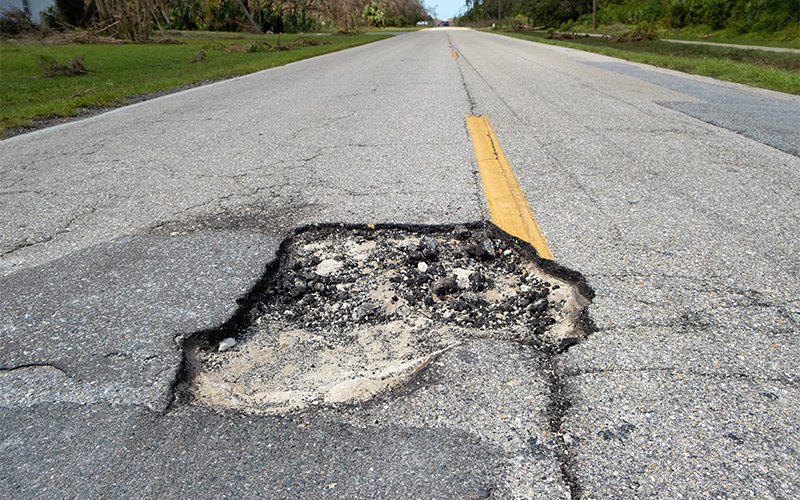
A pothole forms when the surface layer of a road, typically asphalt, begins to crack and break apart under repeated traffic loading. As deterioration progresses, loose material is dislodged, leaving behind a depression with irregular and often sharp edges.
In practical terms, potholes are not isolated defects. They represent a breakdown in the structural integrity of the pavement system. They can begin as small surface cracks, expand across several centimetres in width, and deepen significantly when water and traffic continue to erode the structure. While they can occur across different pavement types, they are most commonly associated with asphalt roads due to their flexible composition.
Without early intervention, even a minor pothole on road surfaces can expand rapidly. This may then increase both repair complexity and long-term maintenance costs.
Why Potholes Keep Recurring in Singapore
Although potholes are a global issue, Singapore’s climate and traffic conditions contribute to their frequency and recurrence. These factors are interconnected and often compound one another over time.
1. Heavy Rainfall and Water Infiltration
Singapore’s tropical climate introduces consistent rainfall, which is a major factor in pavement deterioration. Water infiltrates through existing cracks and penetrates deeper into the pavement layers.
This process weakens the base and subbase materials, softens the supporting soil, and reduces the overall structural strength of the road. Standing water further accelerates erosion, enlarging cavities and deepening existing damage.
2. Traffic Load and Heavy Vehicles
High traffic volumes, particularly from heavy vehicles such as trucks and buses, subject roads to repeated loading cycles. These loads cause pavement flexing, which gradually breaks down already weakened asphalt layers.
Over time, surface materials are dislodged, and fatigue cracking begins to form. The repeated stress is often concentrated at the lower layers of the pavement, where structural failure initiates before becoming visible on the surface.

3. Ageing Pavement
As asphalt ages, its physical properties change. The material becomes more brittle, reducing its ability to flex under load. This makes it more susceptible to cracking, especially in high-traffic environments.
Older pavements tend to deteriorate faster once cracks begin to form. This is because their reduced flexibility limits their ability to absorb repeated traffic loads and withstand ongoing environmental stress, allowing small defects to develop more quickly into structural weaknesses.
4. Inadequate Pavement Structure
In some cases, the issue lies in the original pavement design. If the layers lack sufficient thickness or strength, they are less able to distribute traffic loads effectively. This results in fatigue cracking, where interconnected crack patterns form across the surface.
Over time, these cracks progressively compromise the structural integrity of the pavement. As the underlying support weakens, surface blocks begin to loosen under repeated traffic stress and eventually dislodge, leading to visible surface failure and the early formation of potholes.
What are The Five Stages of Pothole Formation?
Potholes do not form on the road suddenly. They develop through a progressive series of stages, each contributing to structural degradation.
Stage 1: Surface Cracking
The process begins with surface cracks caused by traffic stress, ageing materials, or thermal movement. These cracks may appear isolated at first, but often develop into interconnected patterns.
Stage 2: Water Penetration
Water enters through these cracks and reaches the lower pavement layers. Once inside, it saturates the base and subbase, weakening the supporting structure and reducing load-bearing capacity.
Stage 3: Traffic-Induced Breakdown
As vehicles pass over the weakened area, the asphalt begins to break apart. When small fragments are dislodged, a pumping action occurs, forcing water and fine soil particles out of the pavement. This leads to the formation of a shallow depression.
Stage 4: Environmental Stress
While freeze-thaw cycles are a major factor in colder regions, Singapore experiences a different but equally impactful condition. Persistent rainfall and water accumulation continue to weaken the pavement, accelerating deterioration.
Stage 5: Material Ejection and Expansion
Eventually, loose material is removed entirely under traffic pressure. The cavity deepens and widens as water and vehicles continue to erode the surrounding area. At this stage, the pothole becomes a visible and hazardous defect that requires immediate attention.
What are the Risks and Consequences of Potholes on Roads?
1. Safety Hazards
Potholes introduce unpredictable driving conditions. Drivers may swerve suddenly to avoid them, increasing the risk of collisions. For motorcyclists, cyclists, and pedestrians, the danger is more direct, as uneven surfaces can lead to loss of control or injury.
2. Vehicle Damage
Impact with a pothole can result in a range of mechanical issues. Common outcomes include flat tyres, bent rims, suspension damage, and undercarriage impact. These issues not only incur repair costs but may also disrupt operations for fleet-dependent businesses.
3. Infrastructure and Economic Impact
Recurring potholes disrupt traffic flow and increase maintenance demands. In the long run, they shorten the lifespan of pavement systems and contribute to broader economic losses due to repair cycles, downtime, and operational inefficiencies.
For property owners, similar issues can arise in smaller-scale environments. This makes driveway pothole repair necessary to maintain accessibility and safety within private premises.
Professional Repair Solutions for Long-Term Performance
Effective pothole repair requires more than surface-level intervention. It involves understanding the extent of structural damage and selecting a method that restores both immediate functionality and long-term durability.
As an experienced road contractor in Singapore, United E&P approaches pothole repair as a comprehensive engineering solution. Established in 2013, with a management team bringing more than 30 years of experience in road and airfield construction, we integrate material production, site assessment, and application into a controlled, end-to-end process.
With a state-of-the-art asphalt manufacturing plant and advanced paving equipment, quality is managed from premix production through to on-site execution. This ensures consistency, performance, and alignment with project requirements across varying traffic conditions and site constraints.
1. Cold Mix Patching for Immediate Response
Cold mix patching is commonly applied in situations requiring rapid reinstatement. It is particularly suitable for wet conditions, where traditional methods may not be feasible.
2. Hot-Mix Asphalt for Durable Repairs
For longer-lasting outcomes, pothole patching using hot-mix asphalt is preferred. This method provides stronger bonding and allows for proper compaction, resulting in a more durable repair.
A Structured Approach to Sustainable Road Maintenance
Potholes are not merely surface defects but indicators of deeper structural challenges within pavement systems. Addressing them effectively requires timely intervention, appropriate repair methods, and an understanding of local environmental and traffic conditions.
At United E&P, we adopt structured maintenance strategies and leverage proven repair methodologies to reduce recurrence rates and extend pavement lifespan. Our well-informed approach to pothole management ensures more resilient infrastructure for the future.
Get in touch to learn more about our services.
Connect with us
If you have any questions or enquiries, feel free to reach out to our friendly team anytime; we’re here to assist you!
